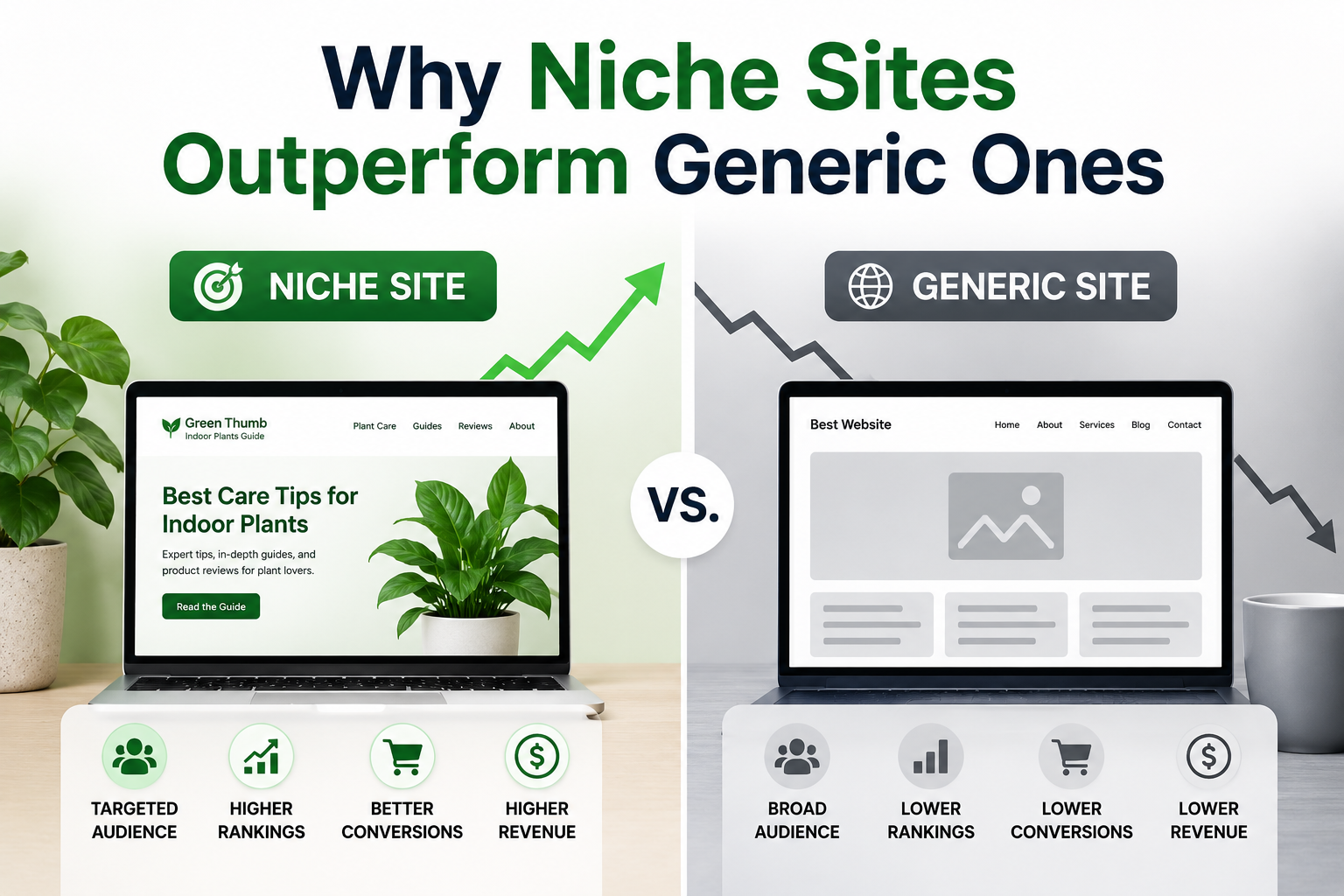
There's a quiet law in web design that most agencies won't tell you, because it makes their job harder: the more specific your website is, the better it performs. Not slightly better — dramatically better. A real estate site built specifically for buyers relocating to a mid-sized Sunbelt city, with neighborhood guides, school district breakdowns, and content that speaks directly to the "I'm moving from somewhere bigger" experience, will consistently outperform a generic "buy and sell homes" site even when the generic site has more traffic. The reason is simple: specificity signals relevance, and relevance is what turns a visitor into a lead.
Search engines have gotten remarkably good at understanding intent, and they reward sites that serve a narrow audience deeply over sites that serve a broad audience shallowly. A hobbyist publication covering a single niche — say, competitive woodworking or vintage synthesizers — often ranks faster and ranks higher than a general-interest site covering dozens of topics, because every piece of content reinforces the same thematic authority. The same principle applies to service businesses. A plumber whose site speaks directly to older homes in a specific city, references the quirks of that city's pipe infrastructure, and answers the questions that homeowner actually has will consistently outrank and out-convert a plumber with a five-page brochure site that could belong to any contractor in any market.
The conversion advantage is where niche sites really separate themselves, though. When a visitor lands on a page and immediately thinks "this is for me," the psychological friction that blocks action — doubt, distrust, the feeling of being just another number — drops significantly. Generic sites create generic trust, which is almost no trust at all. Niche sites can use specific language, specific imagery, and specific social proof (reviews mentioning neighborhood names, testimonials from people in the same situation) that make a visitor feel understood before they've read a single word of copy. That feeling of "they get it" is worth more than any amount of slick design, and it's something you can only build when you know exactly who you're building for.