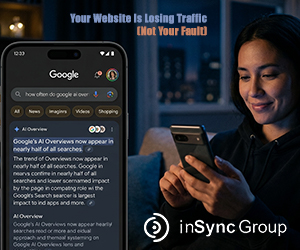
If you've noticed your website traffic dropping over the past year or two despite doing nothing differently, you're not imagining it — and you didn't break anything. Google's AI Overviews (the AI-generated summaries that now appear at the top of search results before any links) are showing up in roughly 47% of all searches, and studies tracking click-through behavior have found they reduce the number of people who actually visit a website by as much as 61%. That means for every ten visitors your site used to get from a particular search query, you might now be getting four. The math is brutal, and it's happening across nearly every industry — local services, retail, professional services, healthcare, real estate. Google is answering the question so users don't have to go anywhere.
The instinct for most small business owners is to double down on the same SEO tactics that worked before — more blog posts, more keywords, more backlinks. The problem is that traditional SEO optimized your site to rank in a list of links. AI Overviews pull from that same content, synthesize it, and put it in front of the user without crediting you with a click. The new game isn't about climbing a ranked list; it's about being the source that AI systems trust enough to quote or reference, and about owning channels that Google's summary box simply can't intercept. That means email lists, direct bookmarks, social audiences that follow you by name, and search queries specific enough that an AI summary can't fully satisfy them — things like "best HVAC contractor in [your city]" or "how much does [specific service] cost near me" rather than broad informational questions where AI thrives.
What this really means practically for a small business is that your website's job description has changed. It's less about capturing cold traffic from generic queries and more about converting people who already know you exist — referrals, social visitors, past customers, local directory clicks. That shifts the emphasis toward things like faster load times, clearer service pages, stronger calls to action, and local SEO signals (Google Business Profile, location-specific landing pages, review volume) that AI Overviews aren't yet as effective at displacing. A well-built site still matters enormously, but the strategy around it needs to reflect the search landscape of 2025 and beyond, not the one that existed five years ago.