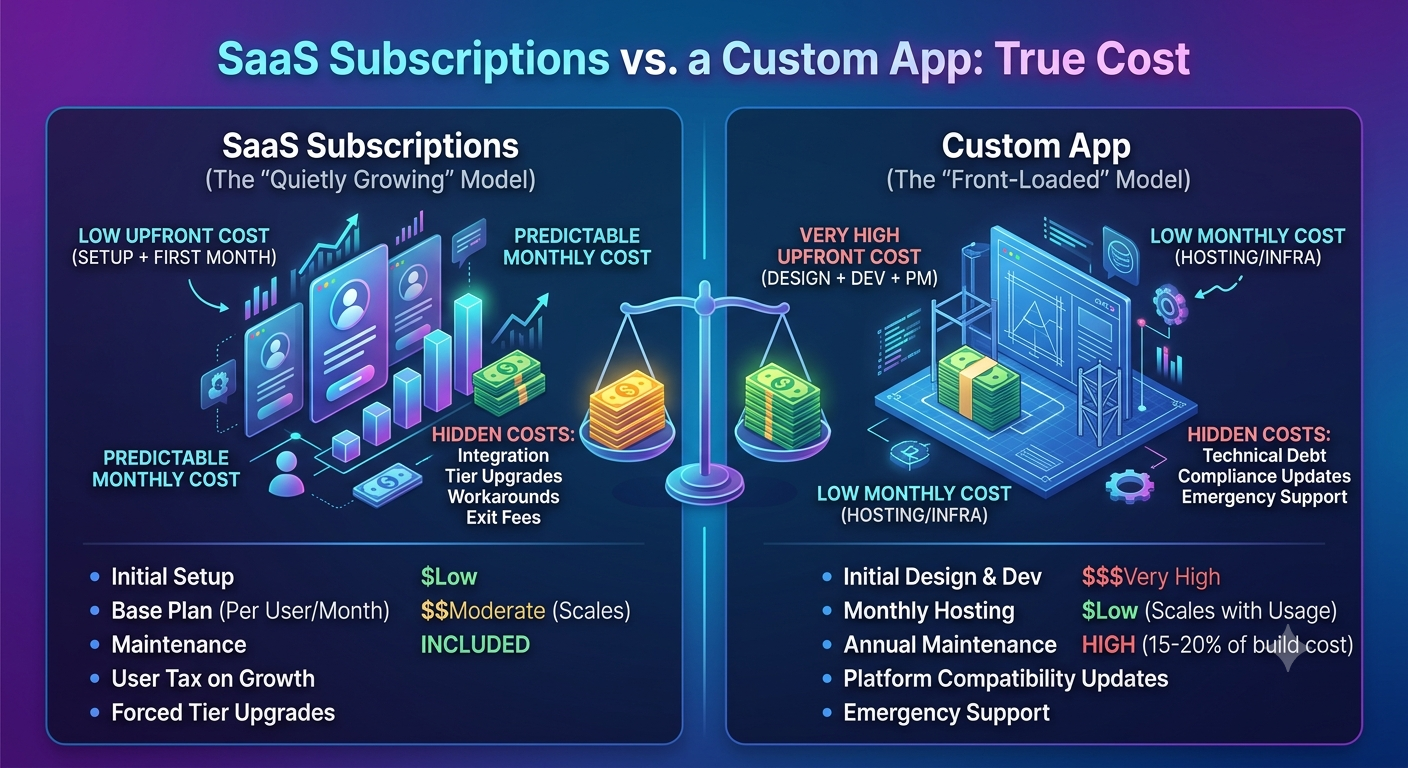
There's a moment most growing businesses hit somewhere around the 8–12 employee mark: the monthly SaaS bill quietly crosses $2,000, and nobody can quite explain why. It usually isn't one expensive tool — it's five or six "affordable" ones at $30–$150 per seat per month, each solving one slice of a workflow that was never designed to fit together. A project management tool here, a CRM there, a client portal bolted on, a reporting layer on top. Each made sense individually. Together, they're paying for four or five partial solutions to a problem that a single purpose-built app might solve completely. The break-even math is simpler than most business owners expect: take your total monthly SaaS spend on tools that overlap or connect awkwardly, multiply by 12, and ask how many years that budget would need to run before it equaled the one-time cost of a custom build. For many small businesses, that number is somewhere between 18 and 30 months — often well within the lifespan of the tool they actually need.
The hidden costs that make this calculus even more favorable are the ones that don't show up on the software invoice. SaaS tools charge for seats, which means your costs scale directly with your headcount whether or not the added users need the full feature set. They also charge for "premium" tiers whenever a feature you actually need sits behind an upgrade wall — and those upgrades have a way of arriving right after you've built a workflow around the free tier. Then there's integration overhead: every time two tools don't talk to each other natively, someone is either doing manual data entry, paying for a middleware connector like Zapier, or living with a reporting gap. A custom app built around your actual workflow eliminates the per-seat model entirely, includes exactly the features your business uses (and none of the ones it doesn't), and can connect to the other systems in your stack without duct tape.
The strongest candidates for a custom build share a few characteristics: they've been using 3+ SaaS tools to approximate a single workflow, their seat count is growing steadily, or they have a process that's genuinely specific to their industry or business model — something no off-the-shelf tool was designed for. A real estate team managing a hybrid of listings, client communications, and document workflows, for example, will never find one SaaS product that handles all three well, because no SaaS company built their product for that exact combination. A custom app can. The goal of this framework isn't to sell anyone on custom development as a default — it's to give business owners a clear-eyed way to recognize when the "cheaper" option has actually become the more expensive one.